
How a Children’s Book Takes Shape
I’m in the middle of writing my next children’s book, a story inspired by my first grandson, Lucas. If you’ve ever thought about writing a children’s book of your own—or you’re simply curious about how one comes together—I thought it might be fun to bring you along. Join me as this story comes together, one memory, rhyme, image, and page at a time.
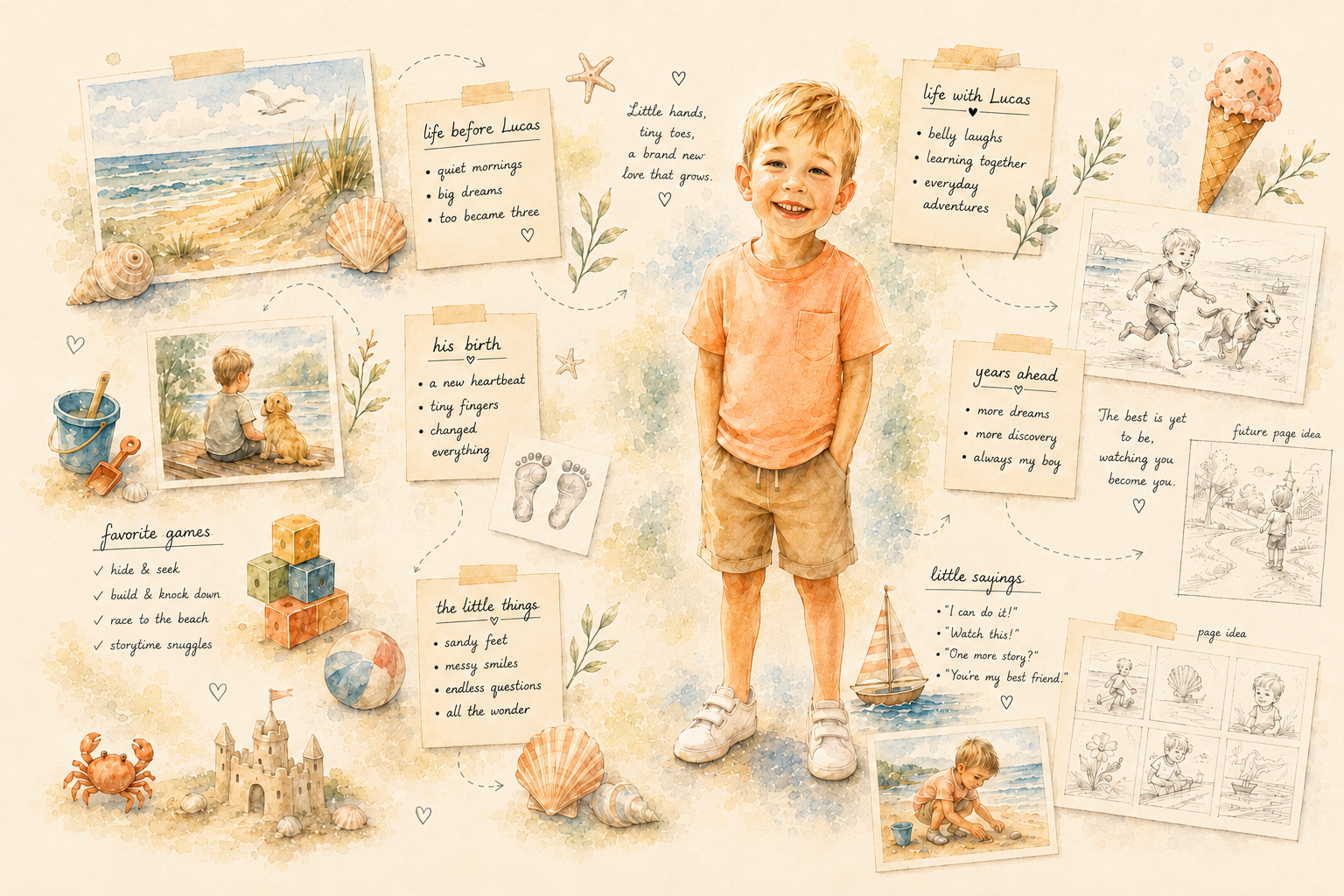
A 32-page children’s book may contain only around 350 words, but deciding which 350 words belong there is where the magic happens. That can feel a little intimidating, which may be why a story you’ve wanted to tell keeps getting pushed aside.
What I’m finding, though, is that the process doesn’t have to feel daunting. It can actually be fun. You gather pieces, try things, move them around, and then one day something begins to click into place.
I’m in the middle of that process right now with a new story inspired by my grandson, Lucas. So instead of waiting until the book is finished, I thought I’d bring you along while I’m still creating it.
This isn’t meant to be a formula. It’s simply the process I seem to return to, and I hope something here helps get your own wheels turning.
“A children’s book doesn’t arrive all at once. It takes shape one piece at a time.”
Start With the Heart of the Story
I like to write stories inspired by real people and real moments—stories that can be passed down and treasured for generations. They mean something to me and my family, but I also hope they have enough reach to touch someone else.
Once I know who the story is about, I usually find myself asking what sits at the heart of that relationship. What is it that makes this person, this memory, or this season worth writing about?
For Lucas, that part was easy.
He made me a grandmother.
That’s the heart I’m building this story around—the joy of holding my first grandchild and all the ordinary little moments that followed.
I’m also writing with one very specific reader in mind: Lucas. As the story comes together, I’m tucking in things he actually loves, does, and says. They’re small details, but they make the story feel more like his.
Before I worry too much about rhyme, illustrations, or page turns, I like to know what I’m really trying to hold onto.
“For me, the story usually starts with the thing I don’t want to forget.”
Find the Arc
Have you ever listened to someone tell a story and wondered, Where is this going? After years of storytelling in corporate America, I learned to pay attention to movement. A story usually begins somewhere, moves through something, and ends somewhere new.
There are plenty of ways that can happen.
A question can grow.
A problem can develop.
A relationship can deepen.
Time can move forward.
A character can learn something.
A repeated pattern can build.
For this story, I’m beginning to see the movement through time and relationship: life before Lucas, his arrival, the bond that grows between grandparents and grandchildren, and the years I imagine ahead.
That arc is still taking shape, but having even a loose sense of where I’m going helps me know which moments belong and which ones probably don’t.
Where does your story begin, and what changes by the time you reach the end?
Write the Story
I should begin with a warning: creating rhymes can be addictive. Once I get started, I can happily keep going much longer than I intended.
There are several rhyme patterns used in children’s books. A few of the most familiar are:
Couplets — AABB: Two lines rhyme, then the next two rhyme.
Alternating rhyme — ABAB: Lines 1 and 3 rhyme; lines 2 and 4 rhyme.
Refrain or repeated rhyme: A recurring line or phrase comes back throughout the book.
I’ve used couplets in the stories I’ve written so far, and that’s what I’m using in Lucas’s new book.
Once I have a draft, I read it out loud. That’s usually where I begin to hear what’s working and what isn’t. A word may feel forced. A line may be too long. Something that looked fine on the page may sound awkward when spoken.
I keep adjusting until the rhythm feels natural to me.
Even then, I don’t assume the words are finished. Once I start pairing them with illustrations, things often move around. I may swap couplets, trim a line, add something new, or realize the picture is already saying something I don’t need to repeat.
That back-and-forth is one of my favorite parts of the process.
“Sometimes the words lead the picture. Sometimes the picture changes the words.”
Build the Page Turns
If God knew I would write children’s stories, I often wonder why He didn’t also give me the ability to illustrate them. Thankfully, I live in an age when technology can help bring the pictures in my head to life.
I won’t get into digital design or AI tools here. I’m more interested in the part that happens before that—figuring out what I actually see when I read the story.
My illustrations tend to be soft and simple—white backgrounds, gentle colors, and plenty of breathing room. Yours may look completely different. You may picture bold colors, detailed scenes, whimsical characters, pencil sketches, collage, or something more realistic.
I don’t think there’s one right look. I just want the visual style to feel like it belongs to the story.
Once I can picture the scenes, I start playing with how much rhyme belongs on each page or spread.
Does a thought need all four lines together?
Would it feel better split into two and two?
Could one line be enough if the illustration carries the rest?
I’m finding that those choices change the pacing more than I expected.
In Lucas’s book, there’s a moment when I hold him and give him my heart. I’m keeping that moment together because I want it to feel like a pause. It needs a little room.
Other moments may move more quickly. Some may work better when a rhyme is split across a page turn. Sometimes I’m realizing the strongest thing I can do is say less and let the picture take over.
As the pages begin to take shape, I’m also looking for little visual connections that can quietly run through the book.
For this story, I think I’ve found one in a shell.
I’m also slipping in a few personal details that most readers may never notice, but my family will. I love that part. It makes the book feel even more rooted in the person who inspired it.
“I’m learning that page turns are less about rules and more about rhythm—where to move, where to pause, and where to let the picture speak.”
Let It Come Together
I’m still building this story, and I think that may be the part I love most.
I don’t have every page figured out yet. Some things will move. Some words will probably change. An illustration may take me somewhere I wasn’t expecting.
That’s okay.
I’m beginning to see that a children’s book comes together through a series of small decisions—the heart of the story, the words, the pacing, the images, the personal details.
You don’t have to see the whole thing before you begin.
Sometimes you just need to start with one memory, one idea, or one person you love enough to write about.
Then you follow it and see where it goes.
“You don’t have to know exactly how the story will turn out. You just have to begin.”
Continue the Journey
If this story encouraged you, I’d love for you to continue the journey with me.
Subscribe to The Journal for thoughtful reflections on faith, family, behind-the-scenes stories, writing inspiration, and practical resources to help you preserve the moments that matter most.
Join The Journal ↓