
The Children’s Book Only You Can Write
The hardest part of writing your first children's book isn't writing the story. It's deciding which story to tell. Sometimes the story you're meant to write has been quietly growing in your heart all along.
Once you recognize it, writing no longer feels like searching—it feels like sharing.
I always knew I wanted to write. I just didn't know what to write.
For years, trying to find that one big idea felt paralyzing.
A few years ago, I attended a writing conference and wandered into a workshop about writing a legacy book. As interesting as I think my own life is, I was fairly certain my children and grandchildren wouldn't be eager to read a long memoir.
Then a simple thought changed everything.
What if, instead of writing about my life, I wrote stories for theirs?
What if I created personalized children's books they could enjoy at the age they were living, while planting lessons and memories that would stay with them as they grew? Stories inspired by our own family, our adventures, our faith, and the moments I hoped they would carry with them for a lifetime.
That single idea became Grand Legacy Press.
Today, every book I write begins with someone I love. Some are written especially for my own family. Others are inspired by experiences, values, and lessons that any family can share. My hope is that each story becomes more than a book—it becomes part of a family's legacy.
One of the greatest surprises has been seeing how deeply these stories have resonated. I've never seen my grown children more excited to receive a gift, and I've met countless parents and grandparents who have quietly carried the same dream: to leave something meaningful for the children they love.
If you've ever thought about writing a children's book, my advice is simple.
Start with the story.
Don't worry yet about illustrations, publishing, or marketing. Those pieces can come later. Begin with the memory, the lesson, the person, or the moment that won't leave your heart.
The rest can be learned.
And that's exactly what this journal is here to help you do.
The Five Ingredients of a Children's Legacy Story
Every meaningful children's book begins with a person, a memory, and a desire to leave something behind. These five ingredients have become the foundation of every book I write, and I hope they'll help you discover the story only you can write.
1. Start with Someone You Love
The first story I knew I had to write was for my son, Joey. It wasn't even my story—it was his.
Part of our bedtime routine was reading together each night. When Joey was about five years old, he began asking if he could tell me a story instead. Out of his imagination came a boy named Soccer and his pet alligator, Wild, who set off on adventures in their yellow helicopter.
Years later, I wanted to preserve that story—not only for Joey, but so one day he could share it with his own daughter, Maddie.
Writing Joey's story released all my writing inhibitions.
I wasn't writing for publishers.
I wasn't writing for strangers.
I was writing for my son.
Suddenly, all the pressure disappeared.
I already knew he would treasure the story because it belonged to him.
So choose your person.
Write the story only you can write for them.
Don't worry about whether it becomes a bestseller.
Write for your audience of one.
Everything beyond that is simply a gift.
2. Root the Story in Real Life
I'll never forget the look on my husband's face when I told him I was going to write a children's book about our grandson Beau's hair.
"His hair?" he asked.
He couldn't imagine how an entire book could be built around a toddler's wild bedhead.
But our family could.
Beau's hair stood straight up in the craziest ways when he was little. It made us laugh, and before long it became part of our family's story. One day, I'm almost certain those photos will make an appearance in his wedding slideshow.
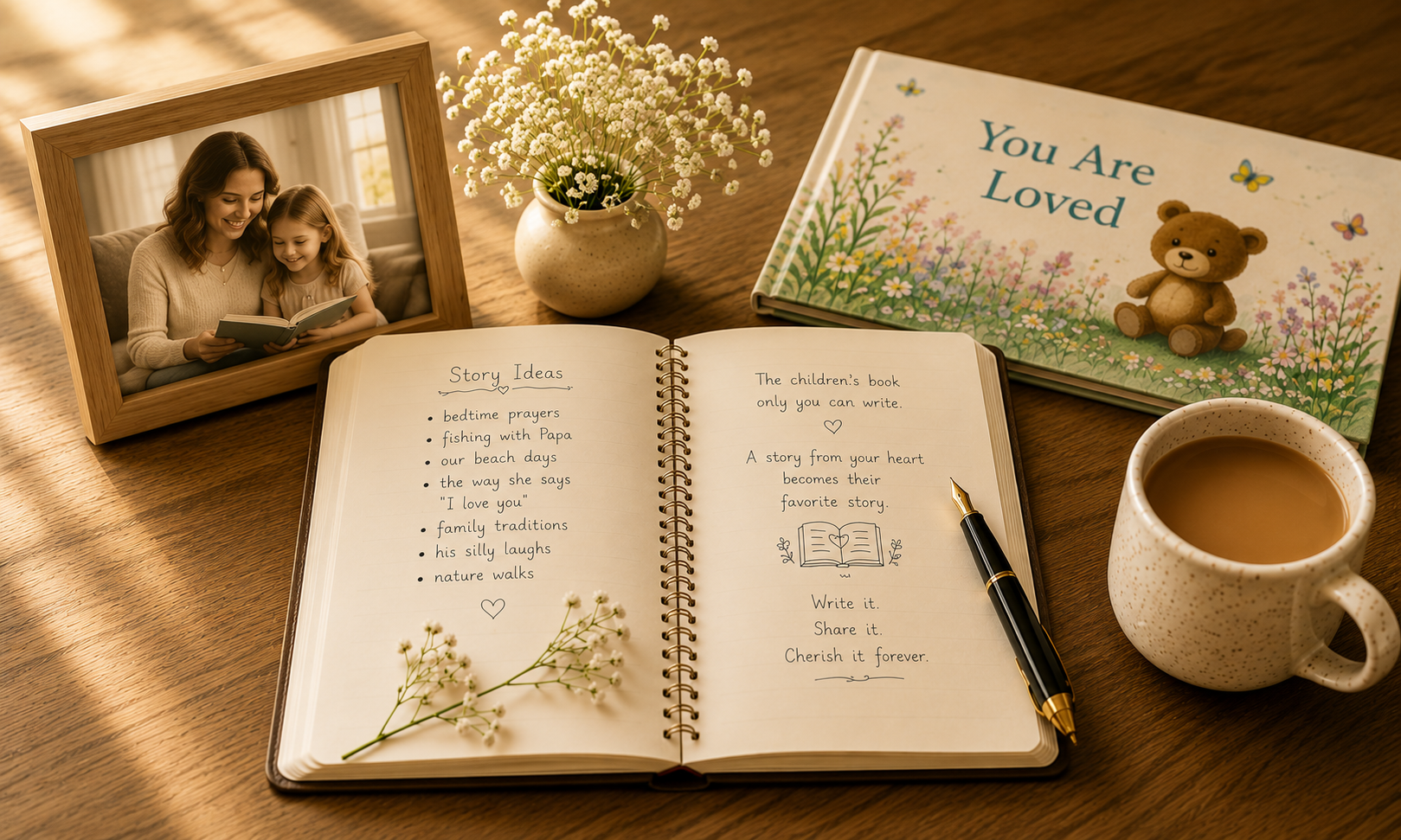
Maybe your story begins with...
Bedtime goodnights
A special prayer
Fishing with Grandpa
Family camping trips
Nature walks
A favorite outing
Inside jokes
Trips to the zoo
A beloved family tradition
The thing that always makes everyone laugh
No memory is too small or insignificant.
If you remember it...
If it still makes you smile...
If you've carried it in your heart...
It may be the perfect place to begin.
The memories that stay with us are rarely the grandest ones.
More often, they're the ordinary moments that quietly shaped our families.
Those are the stories children hold onto.
Those are the stories worth passing down.
3. Plant a Truth That Grows
Every memorable children's story plants a truth that grows long after the last page is turned.
Children are far more likely to remember a truth when they discover it through a story than when they're simply told what to think. There's something magical about watching that truth unfold, one page at a time.
Stories are sticky. They stay with us. We remember them, repeat them, and often carry them into adulthood. A well-planted truth has the power to shape how we see ourselves, others, and even God.
What truth do you want to grow in the heart of the little one you love?
You are wonderfully made.
Kindness matters.
God loves you.
Family is a gift.
Gratitude changes how we see the world.
This truth becomes the heartbeat of your story.
Every scene, every page, and every memory gently points back to it—not by preaching, but by inviting children to discover it for themselves.
4. Write for Two Readers
Children discover the story. Adults rediscover themselves.
The best children's books have something to say to the grown-up reading them, too. They gently remind us of the things we already know but too often forget.
What do you hope the grown-up reading your story remembers?
Slow down.
Treasure ordinary moments.
Embrace the messes.
Laugh more often.
Put the phone away.
See the world through a child's eyes.
Be fully present.
Extend more grace.
Notice God's fingerprints in everyday life.
Wonder is worth protecting.
Love is spelled T-I-M-E.
Childhood passes quickly.
Write a book for little hearts filled with story, adventure, rhyme, wonder, and a simple truth.
Write a book for big hearts filled with perspective, encouragement, nostalgia, gratitude, faith, and a reminder of what matters most.
Every children's book has a child turning the pages—but it usually has an adult reading the words.
Give both of them something they'll carry into tomorrow.
5. Leave a Story They'll Share
What happens after they finish reading your story?
This isn't about the lesson itself. It's about what lingers after the last page is turned.
Maybe a child asks to hear the story again tomorrow night.
Maybe a grandparent and grandchild start talking about a family memory the book reminded them of.
Maybe a parent uses the story to answer a difficult question or begin a meaningful conversation.
Maybe a family begins a new bedtime tradition they'll continue for years.
Maybe, years from now, a grown child reaches for that same well-loved book to read to their own children.
That's when your story becomes more than a book.
It becomes part of a family's story.
Your Story Starts Here
You don't have to invent the perfect story.
You simply have to recognize the one that's already been growing in your heart.
Start with someone you love.
Root it in real life.
Plant a truth that grows.
Write for two readers.
Leave a story they'll share.
One day, someone you love may pull your book from a shelf, gather little ones close, and read your words all over again.
That's more than a children's book.
That's a legacy.
Continue the Journey
If this article encouraged you to begin writing the children's story only you can write, I'd love for you to join me.
Subscribe to the Journal and receive thoughtful articles, writing inspiration, behind-the-scenes stories, and practical resources to help you preserve the moments that matter most.
Join the Journal ↓